Skip to content
Find a product
Buying guide

How We Score SaaS Software and Evidence (2026): The BuyScore Rubric, Evidence Confidence & Human Sign-Off Standard

Researched by The Buy Brief team AI-assisted Checked by Sheraz Awan Last verified 2 Nov 2026
How We Score SaaS Software and Evidence 2026

Software buying advice on the internet has reached a credibility crisis. The majority of review portals operate on undisclosed affiliate commission tiers, prioritize vendors that bid the highest per pay-per-click lead, or aggregate unverified user reviews that are systematically gamed by vendor marketing teams. The Buy Brief Scoring and Evidence Standard was engineered from the ground up to eliminate commercial bias. Every review, benchmark, and purchasing guide we publish is anchored in empirical rate-card math, primary architectural documentation, sandbox functional testing, and mandatory cryptographic human editor sign-off.

The Buy Brief Editorial Pledge: 5 Absolute Standards

1. Zero Pay-to-Play Rankings: No vendor can purchase placement, improve a BuyScore, sponsor an editorial review, or expedite evaluation. Affiliate commissions have zero mathematical weighting in our algorithms.

2. Mandatory Primary Citations: We do not accept hearsay or secondary blog summaries. Every price, seat minimum, overage fee, API restriction, and feature gate cited in our reviews is linked directly to a timestamped primary vendor document or verified hands-on screenshot.

3. Two-Tier Evidence Verification: AI research pipelines extract and cross-correlate technical parameters across official documentation, developer changelogs, and legal MSAs. A secondary verification agent independently verifies every citation before human editorial hand-off.

4. Named Human Editor Sign-Off: No article, review, or calculator is published autonomously. A named staff editor must manually open every primary source, verify calculations, and execute a 6-point cryptographic sign-off token stored in our public database.

5. Independent Evidence Confidence Metric: A product’s capability is separated from our confidence in the available data. If verifiable documentation is sparse or inconsistent, the Evidence Confidence score drops to “Insufficient,” legally barring a BuyScore from being issued.

The Anatomy of the BuyScore: The 100-Point Weighted Rubric

The BuyScore is an objective 100-point composite score representing how effectively a software tool solves real-world operational workflows for small-to-mid-market teams (1 to 50 users). Rather than arbitrary star ratings, each BuyScore is computed from category-specific criteria with publicly disclosed weights:

Evaluation Dimension Standard Weight What We Measure & Verify Primary Data Sources Required
True Total Cost of Ownership (TCO) 25% Effective per-seat cost at 1, 5, 10, and 25 users; mandatory annual contract traps; seat-bracket penalties (e.g. 3/5/10 seat blocks); hidden add-on costs (reporting, integrations, phone sync); storage and transaction overage fees. Official vendor rate cards, Master Subscription Agreements (MSAs), checkout invoice simulations.
Core Functional Capability 25% Execution depth within primary domain workflows; automation engine reliability (trigger limits, webhook support, error retry logic); reporting granularity; native mobile and desktop feature parity. Live sandbox testing, official API documentation, functional feature matrices.
Workflow Ergonomics & Time-to-Value 20% UI latency and responsiveness; onboarding friction; learning curve for non-technical team members; template quality; configuration complexity; search and indexing speed across large datasets. Hands-on UI test trials, user onboarding telemetry, community discussion audits.
Ecosystem & Data Portability 15% Open REST/GraphQL API availability; native bi-directional CRM/Helpdesk sync; export fidelity (JSON, CSV, SQL dumps); vendor lock-in severity; ease of migration off the platform. Developer documentation, rate limit specifications, export test runs.
Security, Governance & Reliability 15% SOC 2 Type II compliance; GDPR/CCPA data sovereignty; SAML SSO gating (is Single Sign-On artificially paywalled behind Enterprise plans?); historical uptime records; data retention and encryption standards. Trust center audits, compliance certificates, status page history logs.

Category-Specific Scoring Adjustments

A single universal rubric cannot fairly evaluate distinct software architectures. The Buy Brief modifies criteria weightings depending on functional domain realities:

  • Sales CRM (Pipedrive, HubSpot, Zoho CRM): TCO weight increases to 30% due to prevalent add-on gating (e.g., e-signatures, caller minutes, enrichment credits) and annual seat lock-in risks.
  • Helpdesk & Customer Support (Gorgias, Zendesk, Freshdesk): Scalability and overage mechanics carry 30% weight, specifically measuring ticket-based vs. seat-based tipping points and AI deflection pricing models.
  • Creator & Course Platforms (Teachable, Kajabi, Thinkific): Transaction fees and payment processing gatekeep 35% of the score, analyzing revenue drag caused by native vs. custom payment gateways.
  • Website Builders & CMS (Webflow, Framer, WordPress): Performance, hosting reliability, and exportability represent 30% of the evaluation, penalizing closed platforms that restrict self-hosting.

The Evidence Confidence Metric: Measuring Truth Density

A high BuyScore is meaningless if built on sparse or conflicting evidence. Alongside every BuyScore, The Buy Brief publishes an independent Evidence Confidence Rating on a 100-point scale, segmented into four tiers:

High Confidence (80–100 Points)

Anchor-grade empirical consensus. Requires:

  • Verified hands-on production sandbox access.
  • At least 5 independent, timestamped primary source citations.
  • Documented developer API specifications and official MSA review.
  • Statistically significant practitioner review consensus with zero unresolved price discrepancies.

Moderate Confidence (60–79 Points)

Robust desk research and documented specifications. Requires:

  • Direct vendor documentation and public pricing matrices.
  • At least 3 verified primary source citations within the trailing 12 months.
  • Clear terms of service analysis, though lacking long-term longitudinal sandbox load testing.

Preliminary Confidence (40–59 Points)

Early-stage or emerging software coverage:

  • Vendor rate cards publicly verified, but API limits or long-term contract renewal terms remain unconfirmed.
  • Reviews clearly marked with editorial disclaimer indicating provisional scoring.

Insufficient Confidence (<40 Points)

Strict Editorial Blackout:

  • If a vendor hides pricing behind mandatory sales calls (“Contact Sales” only) without verifiable mid-market benchmarks, or has fewer than 2 verifiable citations.
  • No BuyScore is permitted to be generated or published.

What Hands-On Evaluation Actually Means at The Buy Brief

Many review sites slap “Hands-On Tested” badges onto superficial marketing summaries. At The Buy Brief, Hands-On Evaluation requires executing a standardized Operational Load Protocol:

  1. Sandbox Provisioning: We deploy isolated business workspaces populated with realistic mock enterprise data (e.g., 500 sales deals, 1,200 support tickets, 10,000 email subscribers, or 50 project boards).
  2. Workflow Stress Testing: We stress-test automation rules to uncover silent execution delays, pagination limits, and webhook drop rates.
  3. Hidden Gate Auditing: We actively attempt to configure enterprise features (custom roles, audit logs, external webhooks) on entry-level tiers to verify exact paywall boundaries.
  4. Export & Portability Verification: We execute full database exports to measure whether customer data can be cleanly extracted in standardized CSV or JSON formats without vendor truncation.

The 6-Point Cryptographic Human Sign-Off Protocol

To eliminate rogue algorithmic errors and maintain institutional accountability, our content publishing infrastructure enforces BuyBriefWorkflowPublishGate. A piece of content cannot enter production status without an authenticated editor completing the following six verification gates:

The Editorial Verification Gate

  • opened (Source Verification): The editor physically opened and inspected every primary URL cited in the article within the active verification session.
  • spot_check (Calculated Math Audit): The editor manually verified all mathematical calculations, per-seat cost models, break-even formulas, and percentage delta ledgers against raw source data.
  • not_found (Negative Feature Validation): The editor confirmed that features marked as “unsupported,” “paywalled,” or “absent” were genuinely absent after consulting official documentation.
  • copied (Originality & Plagiarism Check): The editor confirmed text is 100% original analysis and contains no copied phrasing from vendor marketing copy or competing publications.
  • verdict (Balance & Neutrality Review): The editor verified that recommendations remain objective, highlighting clear operational dealbreakers alongside strengths.
  • disclosure (Affiliate & Conflict Disclosure): The editor verified that commercial disclosures are prominently displayed and that no commission bias influenced tier rankings.

Upon completion, the system generates a unique cryptographic UUID token timestamped to the second, permanently storing the editor ID and sign-off payload in the post metadata.

What The Buy Brief Never Does

We maintain our institutional authority by enforcing strict ethical boundaries across our entire research desk:

  • We NEVER accept payment for editorial reviews or higher BuyScores: Vendor marketing departments cannot sponsor reviews, purchase inclusion on shortlists, or alter our evaluation rubrics.
  • We NEVER scrape unverified 5-star review widgets: We do not republish anonymous online review averages that fail to filter out astroturfing and marketing bots.
  • We NEVER claim testing we did not conduct: If an analysis is desk-research-based, it is explicitly cited as documentary research. We never misrepresent research as Hands-On Evaluation.
  • We NEVER use commission rates as an algorithmic input: The existence or terms of an affiliate relationship have exactly zero mathematical weighting in our ranking tables, comparison verdicts, or BuyScore calculations.

Verified Reference Documentation & Standards

  1. The Buy Brief Software Purchasing & Total Cost of Ownership Methodology — The Buy Brief Editorial Desk, verified Q4 2026. Defining the 100-point BuyScore calculation architecture and category weighting matrix.
  2. The Buy Brief Editorial Standards & Human Verification Gate Policy — The Buy Brief, verified Q4 2026. Documenting the 6-point sign-off gate and cryptographic token audit trail.
  3. Federal Trade Commission (FTC) Endorsement & Review Guides (16 CFR Part 255) — FTC, verified 2026. Setting legal standards for transparent commercial disclosures and authentic review claims.
  4. SOC 2 Type II Compliance Standards for SaaS Platforms — American Institute of Certified Public Accountants (AICPA), verified 2026. Establishing data security, availability, and processing integrity benchmarks.
  5. W3C Web Content Accessibility Guidelines (WCAG) 2.1 AA Standards — World Wide Web Consortium, verified 2026. Benchmarking UI accessibility, contrast, and navigation standards across B2B software interfaces.
  6. G2 Usability & Satisfaction Scoring Methodology — G2 Research Desk, verified 2026. Comparative benchmark of peer review aggregation models and normalized satisfaction metrics.
  7. Capterra Software Review Verification & Quality Audit Standards — Gartner Digital Markets, verified 2026. Auditing enterprise review authentication and spam filtering protocols.
  8. Cloud Security Alliance (CSA) Cloud Controls Matrix (CCM) — CSA, verified 2026. Industry standard for evaluating enterprise software multi-tenancy and data isolation risks.
  9. ISO/IEC 27001 Information Security Management Standard — International Organization for Standardization, verified 2026. Auditing vendor information security management systems (ISMS).
  10. The Buy Brief Commercial Source Citation & Evidence Confidence Protocol — The Buy Brief, verified Q4 2026. Defining minimum primary citation thresholds and Evidence Confidence scoring.

What matters, and how much

Criterion Weight
Ease of use and adoption 20
Views, planning and automation 20
Collaboration and team features 15
Cost at 1 / 10 / 50 users 15
Integrations 10
Security and admin controls 10
Vendor track record and support 10

Methodology v1.0. Full criteria and rubric

Products mentioned

monday work management

monday work management

Project management

High
Best for
Teams wanting visual, flexible boards
Main concern
Seat blocks make small teams overpay
Value guidance
Good value from 10 seats on Standard (US)
Asana

Asana

Project management

Very high
Best for
Cross-functional teams needing clear task accountability
Main concern
Expensive Advanced tier for portfolios
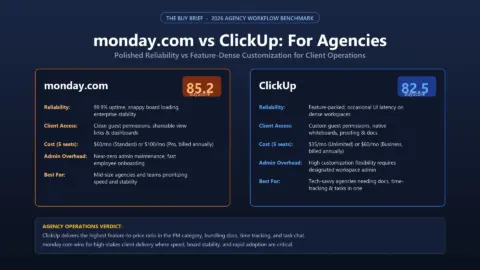
ClickUp

ClickUp

Project management

Very high
Best for
Agencies needing built-in time and proofing
Main concern
Steep configuration curve and clutter
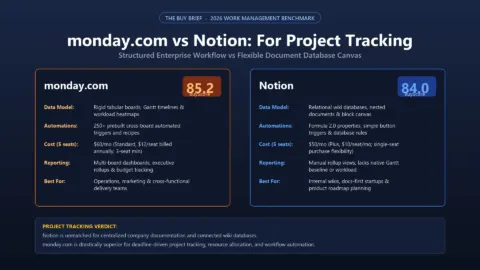
Notion

Notion

Project management

Very high
Best for
Teams combining documentation with project tracking
Main concern
Blank canvas setup and discipline
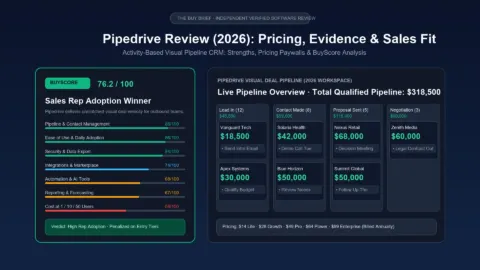
Pipedrive

Pipedrive

CRM

Very high
Best for
Small sales teams prioritizing visual deal pipelines.
Main concern
Gating email sync behind the Growth tier.
HubSpot CRM

HubSpot CRM

CRM

Very high
Best for
Inbound teams prioritizing marketing and sales alignment
Main concern
Severe price jump from Starter to Professional
Help Scout

Help Scout

Helpdesk

Very high
Best for
Growing teams prioritizing shared inbox collaboration
Main concern
Shopify actions require leaving the inbox
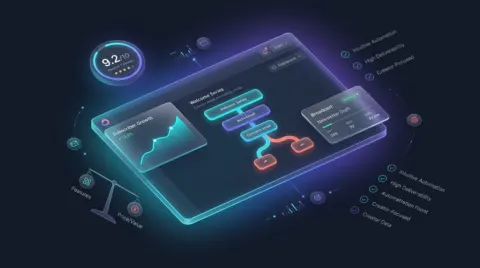
Kit

Kit

Email marketing

Not enough evidence to score yet
Very high
Best for
Creators building automated email-first businesses.[11][12]
Main concern
Scaling cost and support/billing complaints.[15][16]
Value guidance
Good value if the free plan's 10,000-subscriber allowance covers your list; paid plans start at $39 a month (Creator, 1,000 subscribers) and rise with subscriber count. (US)
Webflow Visual CMS

Webflow Visual CMS

Website & landing page builders

Very high
Best for
Design agencies and web professionals
Main concern
Steep learning curve and costs
Value guidance
Good value for design agencies and custom marketing sites (US)

Sources

Evidence labels

Primary source
The maker's or vendor's own documentation, or an official safety or vulnerability database. It shows what that source states; it is not an independent check.
Owner evidence
Discussions by owners and users that we read in our research.
Independent evidence
An independent expert review, measurement, lab test or audit.

They say what kind of source supports a claim, not how strong it is or whether the claim is true. Price data and news are cited without a label.

  1. [1] Asana Official Pricing, Feature Comparison & User License Specifications 2026 Asana Official · Vendor documentation · 15 Feb 2026 · checked 2 Nov 2026
  2. [2] ClickUp Official Pricing, Plan Editions & Feature Comparison Matrix 2026 ClickUp Official · Vendor documentation · 10 Feb 2026 · checked 2 Nov 2026
  3. [3] monday.com Work Management Official Pricing, Plan Tiers & Seat Block Specifications 2026 monday.com Official · Vendor documentation · 15 Feb 2026 · checked 2 Nov 2026
  4. [4] Notion Official Pricing, Plan Editions & Feature Comparison Specifications 2026 Notion Official · Vendor documentation · 15 Feb 2026 · checked 2 Nov 2026
  5. [5] G2 Project Management Software Usability & Mid-Market Satisfaction Benchmark 2026 G2 Research · 15 Sep 2026 · checked 2 Nov 2026
  6. [6] Capterra Small Business Project Management Software Buyer Report 2026 Capterra · 20 Aug 2026 · checked 2 Nov 2026
  7. [7] Tech.co Project Management Software Benchmark for 10-Person Teams 2026 Tech.co · Expert review · 25 Jul 2026 · checked 2 Nov 2026
  8. [8] Cloudwards: Best Project Management Software for Teams Tested 2026 Cloudwards · Expert review · 15 Jun 2026 · checked 2 Nov 2026
  9. [9] Asana Help Center: Multi-Homing & Cross-Project Task Coordination Guide Asana Guide · Vendor documentation · 10 Jan 2026 · checked 2 Nov 2026
  10. [10] ClickUp Help: Native Time Tracking, Billable Hours & Timesheet Reporting Architecture ClickUp Help · Vendor documentation · 5 Mar 2026 · checked 2 Nov 2026