
Pipedrive
CRM
Very high
- Best for
- Small sales teams prioritizing visual deal pipelines.
- Main concern
- Gating email sync behind the Growth tier.
We don't claim hands-on testing unless we actually performed it.
Comparing Pipedrive and Zoho CRM brings into focus one of the most classic trade-offs in sales software: do you prioritize extreme simplicity and pipeline velocity so reps actually log their activity, or do you prioritize exhaustive feature depth, customization, and process automation at an aggressive price point?
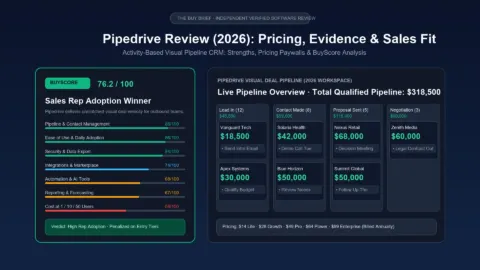
Pipedrive (BuyScore: 76.2 / 100) is the better choice for fast-moving sales teams where adoption and pipeline focus are paramount. Pipedrive’s visual Kanban pipeline, intuitive activity scheduling, and minimalist layout eliminate administrative resistance. Sales reps love using it because it helps them close deals without requiring hours of manual data entry. However, you pay a slight premium for advanced features ($28 to $49/user/month), and email sync is paywalled on the entry tier. (Read our full Pipedrive Review (2026) for in-depth testing data).
Zoho CRM (BuyScore: 81.6 / 100) is the clear winner for organizations that require deep customization, inventory management, and rigid process enforcement on a budget. At $14 (Standard), $23 (Professional), and $40 (Enterprise) per user per month, Zoho delivers unmatched functionality per dollar. Features like Zoho Blueprint enforce step-by-step sales compliance, while Zia AI provides predictive win probabilities. However, buyers must budget for an extensive onboarding learning curve and an interface that feels significantly more cluttered than Pipedrive.
| Evaluation Dimension | Pipedrive (BuyScore: 76.2) | Zoho CRM (BuyScore: 81.6) |
|---|---|---|
| Core Philosophy | Sales-First Simplicity: Visual Kanban deal dragging, activity prompts, zero feature bloat | Modular Enterprise Power: Exhaustive customization, process Blueprints, multi-department hub |
| Entry Plan Pricing | Lite: $14/user/mo (annual) or $24/mo (monthly) | Standard: $14/user/mo (annual) or $20/mo (monthly) |
| Mid / Professional Plan | Growth: $28/user/mo Professional: $49/user/mo |
Professional: $23/user/mo Enterprise: $40/user/mo |
| Process Enforcement | Flexible pipeline stages; reps can freely drag deals between columns | Zoho Blueprint: Mandatory stage progression, required fields, and approval gates |
| Artificial Intelligence | Pipedrive AI Sales Assistant (smart tips, email summaries on Pro tiers) | Zia AI: Predictive lead scoring, sentiment analysis, anomaly detection, best-time-to-contact |
| Ecosystem & Breadth | Focused sales CRM with 400+ third-party marketplace integrations | 50+ Zoho Apps: Native integration with Zoho Books, Zoho Desk, Zoho Campaigns, Zoho Sign |
| Administrative Overhead | Minimal: Self-serve setup in under an hour without technical assistance | High: Complex permission matrices, layout rules, and dense administrative consoles |
The philosophical division between Pipedrive and Zoho CRM is best understood through how each system controls a sales deal.
Pipedrive treats salespeople as autonomous professionals who need a clear visual scoreboard. Deals are cards on a Kanban board. When a meeting ends, the rep drags the deal from “Demo Scheduled” to “Proposal Delivered” and is immediately prompted to schedule their next activity (e.g., follow-up call on Thursday). The barrier to entering data is virtually nonexistent, resulting in industry-leading daily rep adoption rates across sales teams.
Zoho CRM is built for sales leaders who need strict operational governance. With Zoho Blueprint, managers can visually map their exact sales process into the CRM:
For organizations selling complex B2B solutions, franchise systems, or financial products where regulatory compliance and rigid handoffs are mandatory, Zoho Blueprint prevents reps from cutting corners.
Both platforms offer accessible per-seat pricing, but Zoho consistently delivers more advanced functionality at lower price points.
| Sales Team Scale | Pipedrive Annual Cost | Zoho CRM Annual Cost | Feature & Cost Difference |
|---|---|---|---|
| 5 Sales Reps (Standard / Lite Tier) |
$840 / year (5 seats x $14/mo Lite) |
$840 / year (5 seats x $14/mo Standard) |
Price Parity: Zoho includes multiple pipelines and scoring; Pipedrive lacks two-way email sync on Lite |
| 10 Sales Reps (Mid-Tier / Professional) |
$3,360 / year (10 seats x $28/mo Growth) |
$2,760 / year (10 seats x $23/mo Professional) |
Zoho saves $600/yr (18%): Zoho includes Blueprints, inventory tracking, and SalesSignals |
| 10 Sales Reps (Advanced / Enterprise) |
$5,880 / year (10 seats x $49/mo Pro) |
$4,800 / year (10 seats x $40/mo Enterprise) |
Zoho saves $1,080/yr (18%): Zoho includes Zia AI assistant, territory management, and custom portals |
| 25 Sales Reps (Scaling Enterprise) |
$14,700 / year (25 seats x $49/mo Pro) |
$12,000 / year (25 seats x $40/mo Enterprise) |
Zoho saves $2,700/yr: Substantial savings while delivering full enterprise governance |
As the pricing model shows, Zoho CRM delivers substantial cost savings across mid and enterprise tiers while providing features—such as integrated quotes, sales orders, price books, and inventory management—that Pipedrive either lacks or requires third-party paid add-ons to replicate.
Model your exact headcount, feature requirements, and annual CRM expenses below:
Compare true annual software costs between Ticket-Based (Gorgias) and Seat-Based (Freshdesk, Zendesk, Help Scout) helpdesks based on your exact team size, monthly ticket volume, and AI deflection.
Saves an estimated $960/year compared to the next closest rival.
For your current configuration (5 agents, 1,500 tickets), Help Scout and Freshdesk offer the lowest software fees. However, if your team runs on Shopify, Gorgias saves an estimated 25–40 hours per month in direct order actions, easily offsetting the $55/month price difference.
Both vendors have integrated artificial intelligence into their 2026 releases:
CRM

CRM
| Measure | Pipedrive | Zoho CRM |
|---|---|---|
| BuyScore |
76
Good
|
82
Recommended
|
| Evidence |
Very high
|
Very high
|
| Pipeline and contact management | 88 | 84 |
| Ease of use and adoption | 86 | 72 |
| Cost at 1 / 10 / 50 users | 58 | 84 |
| Automation and AI assistance | 68 | 82 |
| Integrations and email sync | 74 | 86 |
| Reporting and forecasting | 67 | 84 |
| Security, data export and vendor track record | 84 | 88 |
| Best for | Small sales teams prioritizing visual deal pipelines. | Scaling businesses wanting deep customization on budget |
| Main concern | Gating email sync behind the Growth tier. | Cluttered interface and steep learning curve |
You prioritize high sales rep adoption and deal velocity with a clean visual pipeline that requires minimal data entry.
You need strict process compliance via Blueprints, integrated quotes and inventory, and deep customization at an affordable per-seat price.
Evidence labels
They say what kind of source supports a claim, not how strong it is or whether the claim is true. Price data and news are cited without a label.